
Our goals for school meals are straightforward: reduce added sugars, expand whole food options, and reduce ultra-processed “fast food” style items. Making these changes takes time, and some improvements are harder than others. But parents can help by learning to read menus carefully and understanding how wordplay on food labels works.
I looked at elementary school menus from February through April 2026 to see what changed. Here’s what stood out.
Good News: Real Reductions in April
- Banana Chocolate Bar: appeared 4 times in February, 4 times in March, essentially gone in April
- Blueberry Muffin: appeared 3 times in February, 3 times in March, removed in April
- Cereal Bars: appeared 2 times in February, removed in later months
- Strawberry Banana Smoothie with Goldfish Graham Cracker: introduced in March, removed in April
- Fruit Juices: reduced frequency
These are meaningful changes that reduced added sugar at breakfast. This kind of reformulation is exactly what we’re asking for, and it deserves recognition. The menu also continues to feature scratch-cooked items like Carne Guisada, Barbacoa Tacos, Soft Beef Tacos, and Beef Tamales. These dishes show the Central Kitchen has the equipment and staff to prepare real food from raw ingredients. Items labeled “Homemade” in March and April (Homemade Chorizo & Egg Taco, Homemade Ranch Style Beans) suggest this capability is being used, which is encouraging.
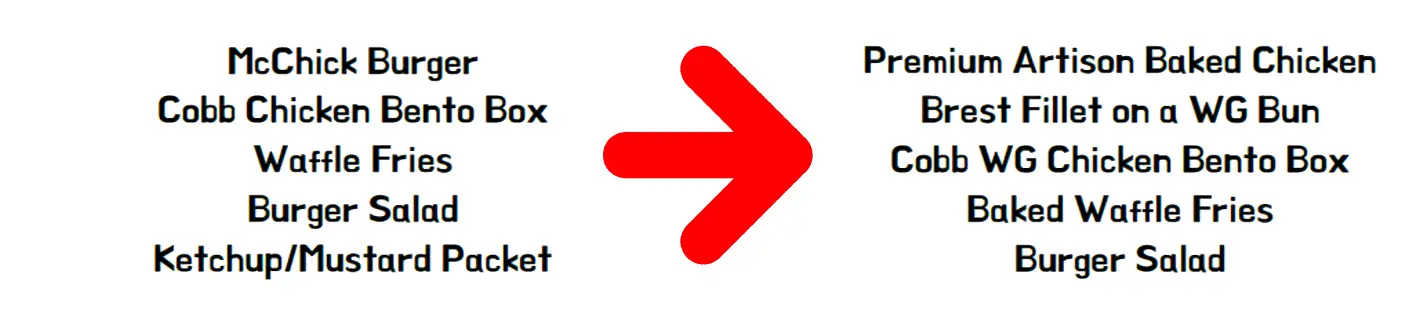
Understanding Wordplay: A Guide for Parents
Here’s where things get interesting. Between February and March, many menu items got renamed. The food stayed the same, but the descriptions changed. This is important for parents to understand because the same wordplay shows up on grocery store food labels.
Look at these transformations:
February: McChick Burger
March/April: Premium Artison Baked Chicken Breast Fillet on a WG Bun
February: Golden Boneless Chicken Wings
March/April: WG Boneless Chicken Breast Chunks
February: Corn Dog Bites
March/April: WG Corn (chicken) Dog Bites
February: Hot Dog
March/April: Hot Dog in a WG Bun
Same products. Different marketing language. Adding “Premium Artisan Baked” doesn’t change what the item actually is – it’s still a frozen chicken patty reheated on site. Adding “WG” (whole grain) to the bun doesn’t change the fact that the main item is an ultra-processed food.
How This Works in the Grocery Store
This same wordplay shows up everywhere once you start looking for it. Walk down any grocery aisle and you’ll see it:
“Made with Whole Grains” – This sounds healthy, but check the ingredient list. It might be mostly refined flour with a small amount of whole grain added. The first ingredient tells you what’s actually dominant in the product.
“Baked, Not Fried” – Many “baked” chips and chicken products were actually fried in the factory, then frozen. Reheating them in an oven doesn’t make them less processed. Check for “partially fried” or “par-fried” in the ingredient list.
“Real Fruit” – Could mean the product contains a small percentage of actual fruit mixed with fruit-flavored corn syrup and artificial colors. Look at how far down the ingredient list “strawberries” or “blueberries” actually appear.
“Vegetable Oil” – Sounds healthier than it often is. When a product says “whole grain crackers made with vegetable oil,” that vegetable oil is usually highly processed soybean or canola oil, sometimes partially hydrogenated. The “vegetable” part sounds wholesome, but it’s still processed fat.
“Reduced Sugar” or “Less Sugar” – Reduced compared to what? Their own previous formula? A competitor’s product? Without the baseline, this claim doesn’t tell you much. A “reduced sugar” cereal could still have 10 grams of sugar per serving.
“Natural Flavors” – This is a regulated term, but it doesn’t mean what most people think. Natural flavors are often created in labs from natural source materials. They’re not necessarily closer to whole food than artificial flavors.
The pattern is the same: upgrade the language to create a health impression without changing the actual product. This isn’t lying – the statements are technically accurate – but they’re designed to make you feel better about processed food.
What to Look For Instead
When you’re reading school menus or food labels, here’s what actually matters:
Ingredient lists: The first few ingredients are what the product mostly contains. If the first ingredient is refined flour or sugar, that’s what you’re mainly eating, regardless of what else is in there.
Specificity: “Homemade Chorizo & Egg Taco” is more informative than “Breakfast Taco.” “Broccoli florets” is more informative than “Chef’s Choice Veggie.” When menus get vague, ask questions.
Actual food names: Items that sound like real food (Carne Guisada, Barbacoa Taco) are usually closer to scratch cooking than items with marketing names (Premium Artisan Baked Chicken Breast Fillet).
What’s missing: If a menu claims “served with fresh fruit” but doesn’t list which fruits, that’s a transparency gap. If it says “reduced sugar” without saying what the actual sugar content is, that’s marketing, not information.
The Bigger Picture
Looking at these three months of menus, ultra-processed items and vegetable offerings stayed mostly consistent. That’s not surprising – changing food service operations takes time, especially when you’re feeding thousands of kids daily. Some changes require new equipment, new supply contracts, or retraining kitchen staff.
But parents can help by learning to distinguish between real menu changes and language changes. When the April breakfast menu removed those sweet items, that was a real change. When the March menu added “WG” and “Premium Artisan” to existing items, that was a language change.
Both matter, but they matter differently. Real changes improve what kids eat. Language changes affect how we feel about what kids eat. Being able to tell the difference helps parents advocate more effectively and helps districts understand what we’re actually asking for.
The goal isn’t to criticize the food service staff who work hard every day to feed our kids. The goal is to help everyone – parents, staff, and administrators – get better at looking past marketing language and focusing on the actual food. When we do that, we can have more productive conversations about what changes are possible and what progress actually looks like.